

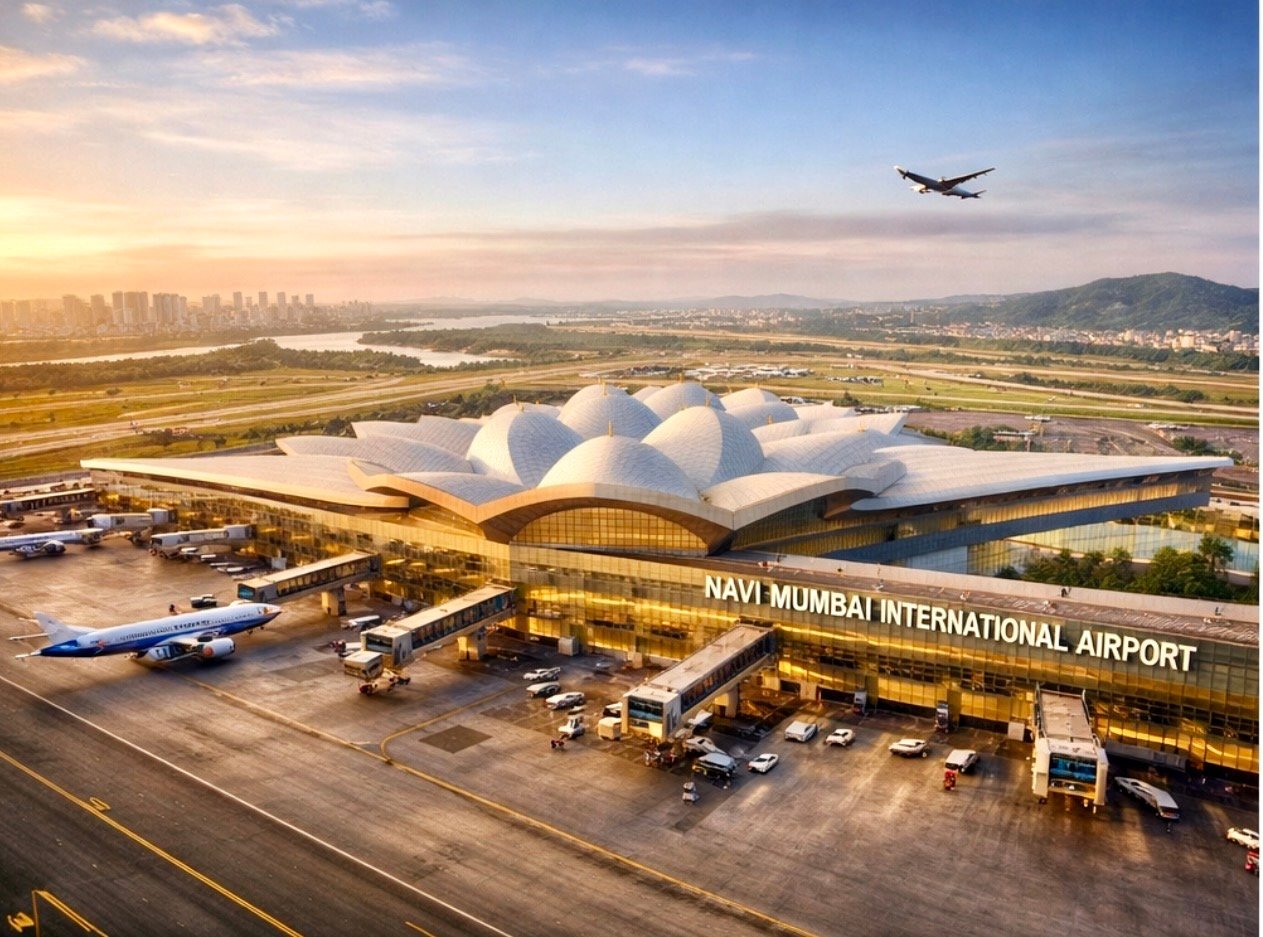
The launch of the Navi Mumbai International Airport (NMIA) marks one of the most historic developments in India’s aviation sector. Set to begin commercial operations on December 25, 2025, the new airport represents a transformative shift for the Mumbai Metropolitan Region (MMR), which has long relied solely on the Chhatrapati Shivaji Maharaj International Airport (CSMIA). As Mumbai’s air traffic has grown beyond its existing capacity, the need for a second major airport has become essential—and NMIA arrives as the long-awaited solution.
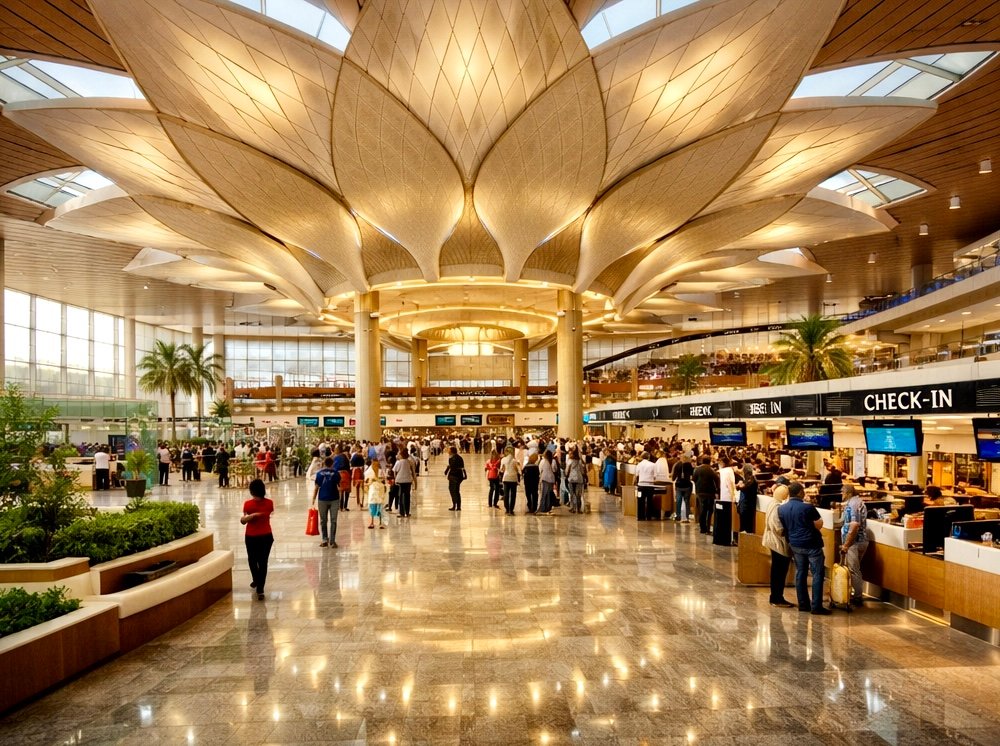
This world-class, next-generation airport is designed not only to ease the pressure on CSMIA but also to enhance regional connectivity, improve passenger experience, and boost economic development across Maharashtra. From its architectural elegance to its advanced digital systems, NMIA is poised to redefine the standard of air travel in India.
⸻
A Vision Realized: The Need for a Second Airport
For years, Mumbai has been one of the busiest aviation hubs in India, handling millions of passengers annually. However, with growing domestic and international travel, CSMIA faced saturation. Runways were overburdened, flight delays were common, and future expansion was nearly impossible due to surrounding infrastructure limitations.
The Navi Mumbai International Airport project was conceptualized as a strategic response to this challenge. Located in Panvel, the new airport sits in a rapidly developing zone. It promises better accessibility for passengers from Navi Mumbai, Thane, Belapur, Kharghar, Raigad, and several industrial corridors. Its opening is a milestone not only for aviation but also for urban development and economic growth.
⸻
Opening Date and Initial Operations
According to the official timeline, NMIA will start commercial flight operations on December 25, 2025. The initial phase includes:
• Operating from 8:00 AM to 8:00 PM during the first few weeks
• Gradual expansion to full 24×7 operations expected by early 2026
• Handling over 20–25 domestic flights daily in the beginning
• Expanding routes, capacities, and flight frequencies by mid-2026
This phased rollout allows systems, staffing, and passenger services to stabilize before full-fledged international operations begin.
⸻
A Masterpiece of Architecture and Technology
One of the most impressive aspects of NMIA is its lotus-inspired architectural design. The terminal features elegant curves, airy interiors, and a modern aesthetic reflecting Indian culture blended with futuristic styling.
Key architectural highlights include:
• A climate-responsive structure
• Large glass facades for natural lighting
• Energy-efficient designs aligned with global green-building standards
• Spacious waiting halls to avoid crowding
• Advanced ventilation and indoor-air quality systems
The design aims to create an airport experience that feels open, refreshing, and traveller-friendly—avoiding the congestion that Mumbai’s primary airport often faces.
⸻
Cutting-Edge Digital Systems
NMIA is set to be one of India’s most technologically advanced airports. The terminal integrates smart systems that streamline passenger movement and enhance safety.
Digital features include:
• Automated check-in and self-baggage drop
• Facial recognition–based DigiYatra support
• Real-time flight tracking across displays and mobile apps
• Smart security lanes to reduce wait times
• High-speed free Wi-Fi throughout the facility
• Digital wayfinding for travellers unfamiliar with the terminal layout
These features aim to ensure a seamless, hassle-free experience that keeps pace with international standards.
⸻
Airline Operations and Early Routes
The first commercial flight to land at NMIA will be operated by IndiGo, marking the symbolic beginning of operations. Initial domestic destinations will include major Indian cities such as:
• Bengaluru
• Hyderabad
• Delhi
• Chennai
• Ahmedabad
• Goa
• Jaipur
Airlines such as IndiGo, Akasa Air, and Air India Express are expected to begin operations immediately in the first phase. As the airport expands, it will open more domestic routes and later move toward international connectivity.
By the second quarter of 2026, NMIA is expected to handle both short-haul and long-haul international flights, helping decongest the existing Mumbai airport and increasing India’s global aviation footprint.
⸻
Infrastructure and Future Capacity
One of the biggest advantages of NMIA is the room for expansion. The master plan includes:
• Four passenger terminals
• Two parallel runways
• A capacity of 90 million passengers annually when fully completed
• Cargo facilities to boost import-export activity
• Dedicated metro and road links connecting Mumbai and its suburbs
Initially, the airport will open with one runway and one operational terminal. However, the phased construction ensures that the airport will continue expanding for the next decade to meet growing aviation needs.
⸻
Economic Impact and Regional Development
Beyond air travel, NMIA will serve as a catalyst for massive economic development in areas surrounding Navi Mumbai and Raigad. The airport is expected to:
• Generate thousands of new jobs in aviation, logistics, retail, and hospitality
• Attract foreign investment into Maharashtra
• Boost tourism and business travel
• Support local industries by reducing travel time and increasing air cargo efficiency
• Improve real-estate growth in Panvel, Kharghar, Ulwe, and Belapur
For many businesses across western India, this new airport will significantly improve accessibility and supply-chain speed.
⸻
Improved Connectivity and Transport Links
Accessibility has been a major part of the planning. Passengers will soon be able to reach the airport through:
• Upgraded highways and expressways
• A dedicated metro link connecting Navi Mumbai to the airport
• Improved local bus and shuttle services
• Potential future connection to Mumbai Trans-Harbour Link (MTHL)
These connectivity improvements ensure that NMIA becomes an integrated travel hub rather than an isolated facility.
⸻
A New Chapter for Indian Aviation
The opening of the Navi Mumbai International Airport is more than just a new transport facility—it represents India’s ambitions as a global aviation leader. With modern design, advanced technology, vast capacity, and strategic connectivity, NMIA is set to become one of the most important airports in South Asia.
As it begins its journey on December 25, 2025, NMIA promises to transform the travel experience for millions while supporting economic progress for decades to come.
⸻